Experimenta is dead

What is the role of an art and technology organisation in 2026?

In 1996 I visited an Experimenta exhibition in the decaying La Trobe Street power station, a cavernous decommissioned industrial plant in the middle of Melbourne city. Walking through dark corridors to find otherworldly and futuristic installations felt dangerous, the show was charged with electricity as it attempted to define a vision of the future that was yet to emerge. Utopian, dystopian, the next five minutes…

I decided then and there that this is what I wanted to do. Artists like Ian Haig, Philip Samartzis, Martine Corompt, Philip Brophy were in this show and I found out that these people taught art at a place called RMIT Media Arts. I made it my mission to be there. After studying there, thirty years later, I count them as friends and mentors.

So it’s with sadness that I open my email in late June 2026 and see that Experimenta has gone into receivership and is no longer an active organisation. State and federal funding collapse? Same curator and curatorial vision for the last twelve years? Still hanging onto a model of expensive national touring? All potential factors for the decline.

The influential Experimenta magazine MESH, which I read avidly as a young man, pointed to a new world of interconnected nodes, memetic replication, always-on broadband consciousness and disruptive technological social upheaval. That infrastructure wave has now arrived and provided for uninterrupted doom/hope scrolling, GenAI Sloptivism, OnlyFans, LLM psychosis, facebook boomer radicalisation, pervasive data-mining and geo-tracking. The shadowy cyberpunk vision I fantasised about as a 17 year old surfing the mailing lists and forums has been embraced, made safe and sold back to me. Nothing is beyond capture.

Talking about mid to late 90s net.art culture feels like telling ‘Grandpas old war stories’, a far off place of adventure and mystery, a swashbuckling semiotic counter-culture where anonymous language agents such as Netochka Nezvanova stalked the discourse. Weaponised ciphers wielded as a attack vectors. Midnight coding, high on instant coffee, 28.8k modem chirping, eight hours of sleep is unnecessary. “Yeah yeah, Jodi, irrational.org, Nettime mailing list, Tactical Media — go back to sleep gramps”.

My small contribution to the legacy of this organisation was Experimenta Social, a series I devised, curated and hosted from 2016. An informal audiovisual salon where artists, audiences and *ultra-hobbyists* could meet each other, listen to presentations and ask questions. Produced alongside Nicky Pastore and hosted at ACMIX, I was happy with the program I developed to profile the work of Sean Dockray, Lara Thoms, Eugenia Lim, Philip Brophy, Holly Childs, Christopher LG Hill and Matthew Sleeth amongst others.

I hope there is an effort to create an online archive of the publications and activities produced by Experimenta and this Australian media art legacy doesn’t evaporate into landfill or e-waste recycling bins. It seems the credit cards have been seized, hosting bills haven’t been paid and the website is already down.

Experimenta needed one more shapeshift, one more shedding of skin, like it did when it left the name Modern Image Makers Association to become Experimenta in the mid-nineties… it missed that one last reinvention to stay relevant.

Dear friends and supporters of Experimenta,

We are writing with the sad news that after four decades at the forefront of media arts in Australia, the board of Experimenta has made the decision to wind down the organisation in 2026. Despite sustained efforts to diversify income and adapt our operating model, the reduction in public arts funding at both the federal and state levels has made it impossible to sustain operations at the level required by Experimenta’s mission.

On 18 June 2026, Garth O’Connor-Price of William Buck was appointed as Liquidator of Experimenta. Should you have any queries in relation to claims, we encourage you to contact his office on (03) 9824 8555 or via email at vic.creditorinfo@williambuck.com.

Founded in 1986, Experimenta has been a pioneering force in commissioning, exhibiting and touring contemporary art shaped by technology. From its origins as the Modern Image Makers Association to its evolution into a globally recognised arts organisation, it has consistently championed artists working at the intersection of art, science and technology, helping redefine the boundaries of contemporary practice. Across almost 40 years, Experimenta has built a remarkable legacy. It has supported generations of artists, from emerging voices to internationally recognised practitioners, while fostering ambitious, collaborative works that bring together technologists, scientists, researchers and creatives. Its triennials, which include a national touring program, have reached audiences across metropolitan and regional Australia, expanding public engagement with new and experimental art forms and contributing significantly to their development in this country.

Experimenta’s work has never been confined to traditional formats. It has embraced creative coding, robotics, bio art, virtual and augmented reality, and data-driven practices, encouraging audiences to explore complex contemporary issues and to reflect on what it means to be human in an age of rapid technological change.

We extend our deepest gratitude to the many supporters, both public funders and private donors, who have sustained Experimenta over its lifetime, to the organisation’s past and present staff, and to the extraordinary artists from across Australia and internationally who have worked with Experimenta over the last four decades.

Experimenta’s impact will endure in the artists it has supported, the audiences it has inspired, and the ideas it has brought into the world. While the organisation’s operations are drawing to a close, its influence will continue to shape the evolving landscape of art and technology for years to come.

Yours sincerely,

The Experimenta Board
Daniel Crooks, Kelly Gellatly, John Merakovsky, Emma Parker & Pinky Tang
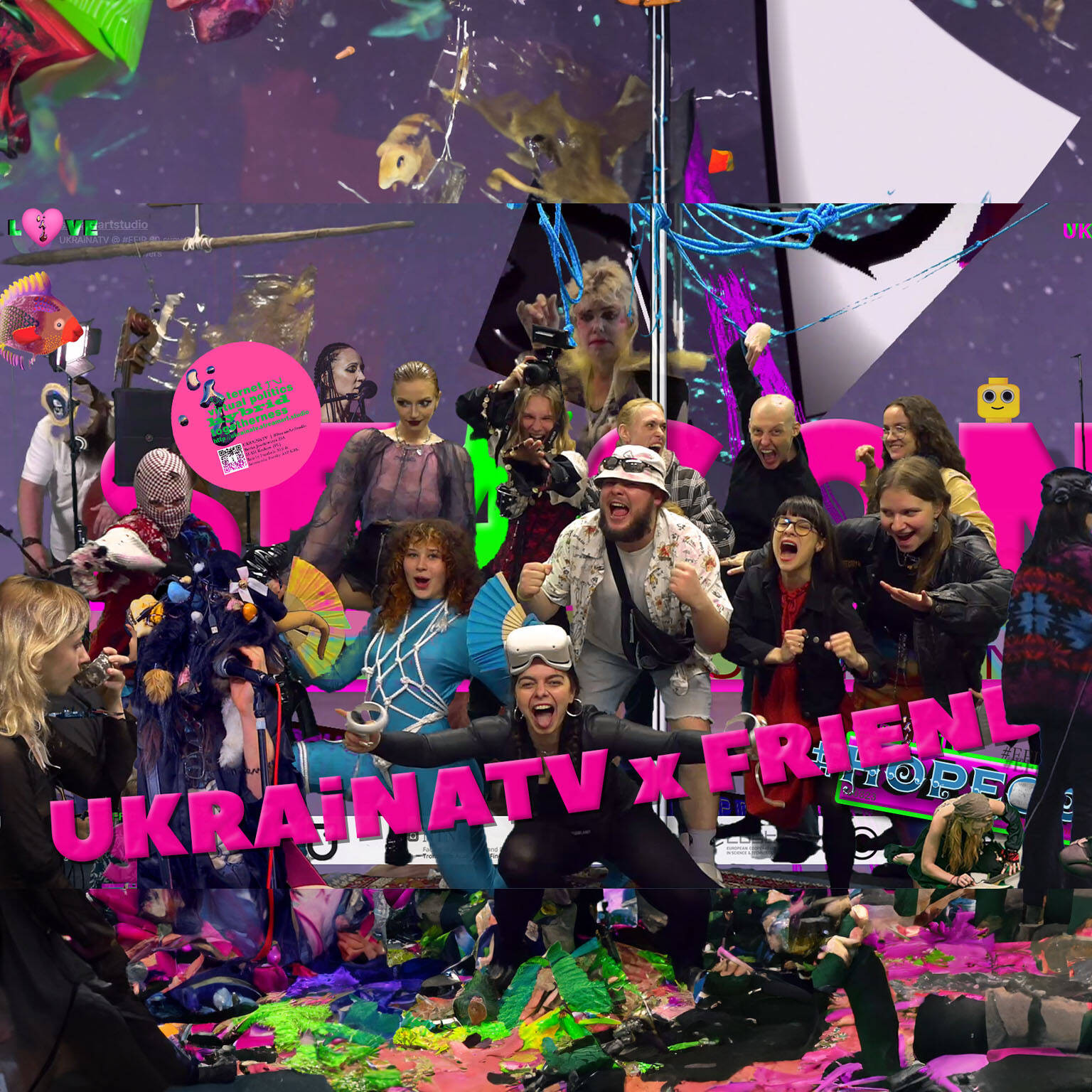
ACMI ART+FILM: UKRAiNATV

Join us for a conversation with founders of UKRAiNATV, moderated by Geert Lovink and Emile Zile.

https://www.acmi.net.au/whats-on/artfilm/ukrainatv/

UKRAiNATV is an experimental media project and Internet TV station that blends real and virtual worlds through live audiovisual bridges, streaming and global networks. Based in Krakow, Poland, it brings together artists, activists, musicians and media enthusiasts from Ukraine, Poland, Belarus and beyond – many of whom are refugees or nomadic creators unable to express themselves freely in their own countries. Founded in response to the Russian invasion of Ukraine in 2022, UKRAiNATV aims to create a space of solidarity and safety for marginalised communities.

Operating from #StreamArtStudio, the collective mixes new and used equipment to produce innovative, hybrid content, connecting people worldwide through transnational collaborations. Despite its instability, UKRAiNATV is a powerful hub that explores the intersection of art, politics, and media in times of conflict and change. It is one of the most experimental and resource-limited TV networks in the world, born out of a need for creative and humanitarian expression.

About Geert Lovink
Geert Lovink is a Dutch media theorist, internet critic and author of Sad by Design (2019) and Stuck on the Platform (2022) and Extinction Internet. He received his PhD from the University of Melbourne. In 2004 he founded the Institute of Network Cultures (www.networkcultures.org) at the Amsterdam University of Applied Sciences (HvA). In 2022 he was appointed Professor of Art and Network Cultures at the University of Amsterdam Art History Department. Since early 2022 he has been involved in support campaigns for Ukranian artists, in particular UkrainaTV, a streaming art studio/network, operating out of Krakow.

About Emile Zile
Emile Zile is an artist, filmmaker and performer. Using the overlooked remnants of network culture to create his performances, films and exhibitions, Emile engages with the boundaries of language to explore contemporary digital selfhood.

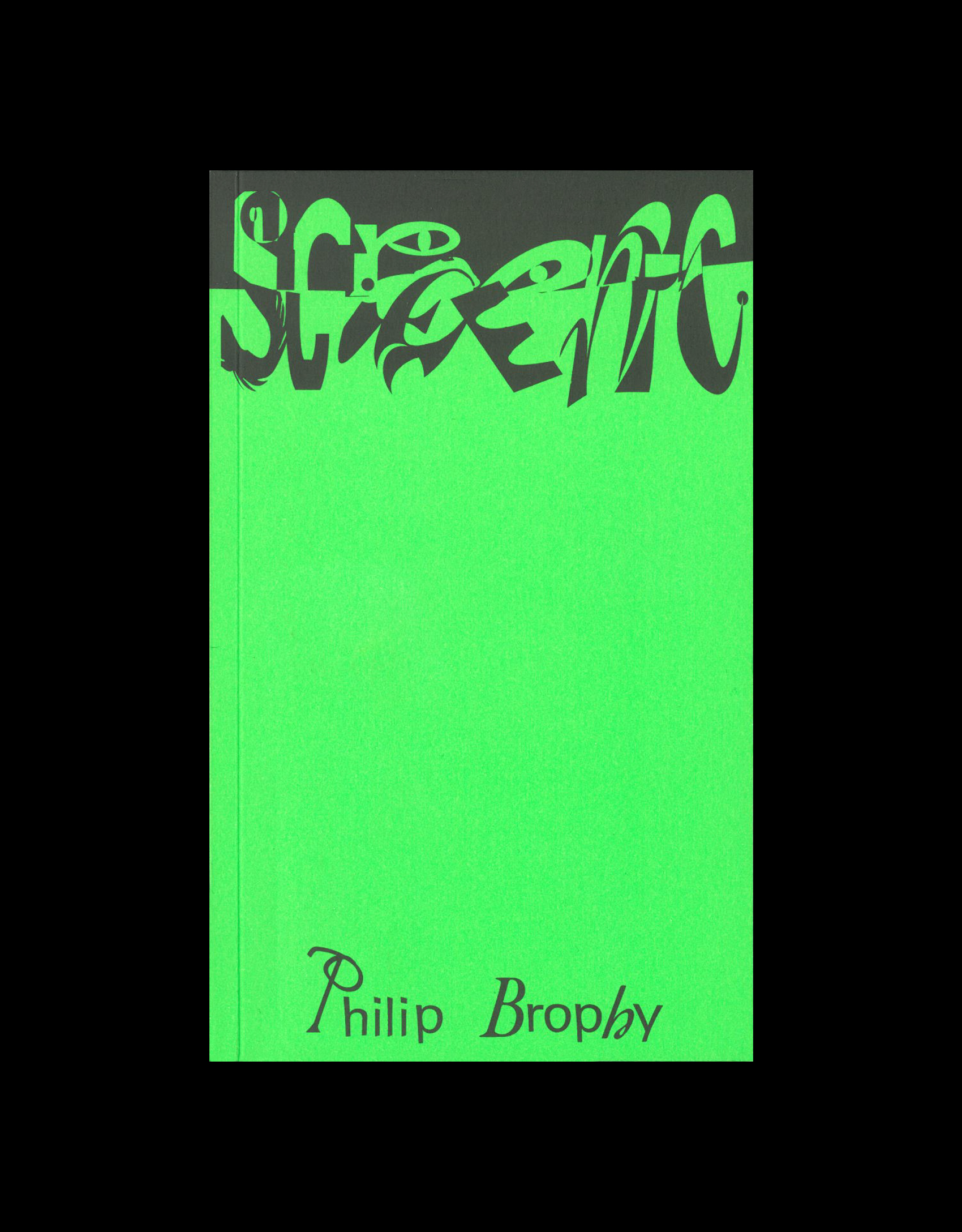
Philip Brophy — Screenic: Politicised Writings on Being Screened

Philip Brophy
Screenic: Politicised Writings on Being Screened
290 pages, softcover, 110 × 180 mm
Edition of 700
ISBN 978-1-7635372-1-7
http://www.discipline.net.au

Discipline is pleased to announce its latest title, Screenic: Politicised Writings on Being Screened—an anthology of Philip Brophy’s writing on art over the last twenty-five years. The focus of the selection is on art that involves screens: projected as film in museums, digitised for installations in galleries, curated as documents within exhibitions, presented as outdoor illuminations on buildings, utilised for the production of VR and AI-generated content, and even wall murals derived from televisual screens. The driver for the writing of these articles is an interest in media literacy within fine art contexts. Together, the articles reinforce the view that ongoing changes taking place in the mediascape over the last two decades create challenges for artists, producers, curators, viewers, and critics—sometimes resulting in a rejuvenation of how media art can be imagined and presented, other times evidencing an anaemic grasp of the contemporary mediascape that whorls outside the white cube.

Screenic has been designed by James Vinciguerra and Duncan Blachford, and printed in Narrm/Melbourne by Documents on Call. It features a preface by Helen Hughes, an introduction by Emile Zile, and has been edited by Olga Bennett.

The Reader

The reader is the audience. The reader is the market. The reader is the critic. The reader is the buyer. The reader is the voice in your head.

Over the course of the Stallholder Fair, Emile Zile will read publicly, privately, obviously, convulsively, discreetly, silently, annoyingly, desperately, lazily.

https://artbookfair.melbourne

Melbourne Art Book Fair
23 May – 02 June
Great Hall, NGV International
180 Saint Kilda Road, Southbank Melbourne, VIC, Australia

4500 Lumens, NGV Triennial EXTRA Performance

4500 lumens
Emile Zile

Continuing with his ongoing interest in light as a carrier of information, be it the projected image, shadow play or expanded cinema performance, Emile Zile presents a new performance in the Gothic and Medieval galleries of NGV International for Triennial EXTRA. Referencing the scientific measurement of light and the once-new technology of the candle as a participant in the development of the Western artistic tradition, his new performance takes place in a subdued, dark environment surrounded by five hundred year old devotional wood carvings.

Emile Zile is an artist, filmmaker and performer. Utilising a darkly comical re-use of media broadcasts, communication protocols and online platforms, his work reflects a distributed humanity, a yearning for transcendence and the limits of language. Emile Zile is a PhD candidate at Digital Ethnography Research Centre RMIT and is profiled in ‘Australiana to Zeitgeist: an A to Z of Australian Contemporary Art’ 2017 Thames & Hudson and ‘Companion to Mobile Media Art’ 2020 Routledge.

Jan 29, Feb 3, 6, 8, 10, 12
8:00 – 8:20pm
Gallery 13 Level 1

Pandemic Playlists

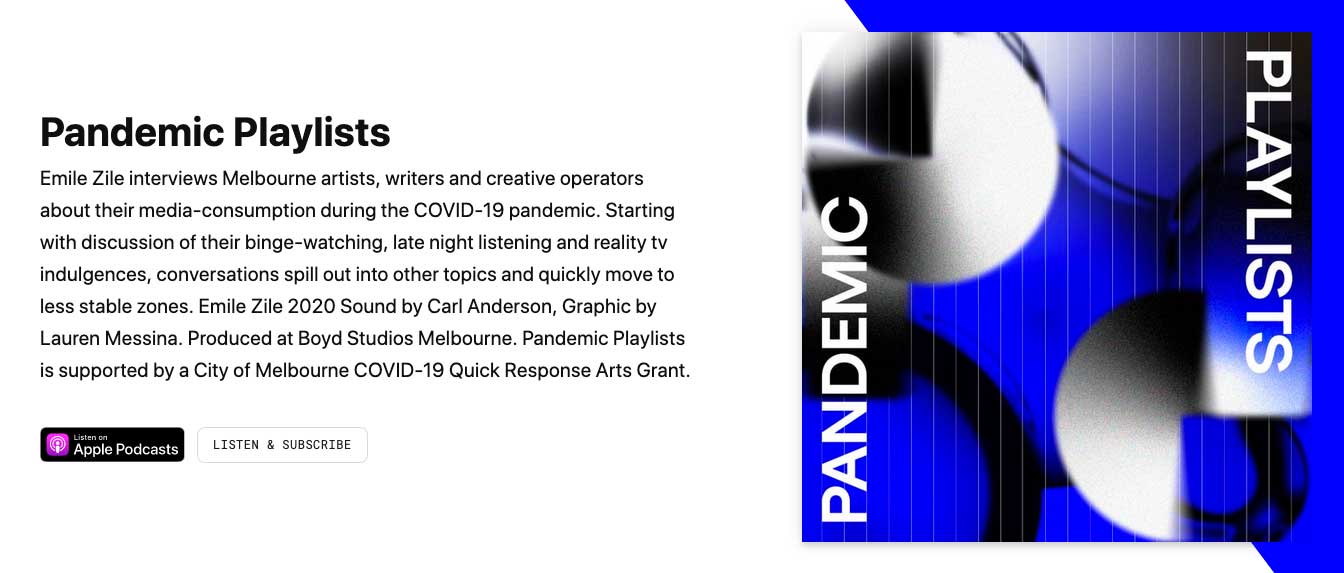
During Plague 2k20 *the big PAUSE* I have been having conversations with Melbourne-based artists, writers and creative operators about their responses to COVID-19 and what media they are consuming while under quarantine, lockdown, isolation and/or temporary hiatus… While our bodies are slowed and our antennas are raised I’ve tried to capture some of the social histories of CV-19.

Subscribe on all major podcast platforms [Apple, Spotify, Google, WWW, RSS]

https://pandemicplaylists.simplecast.com
pandemicplaylists@protomail.com

Sound by Carl Anderson, Graphic by Lauren Messina.
Pandemic Playlists is supported by the City of Melbourne Covid19 Quick Response Art Grants.

Audience/Performer/Lens (after Dan Graham) performance at LIMA Amsterdam

https://www.li-ma.nl/lima/news/unfold-audienceperformermirror

On the 15th of January 2020 LIMA invites Keren Cytter, Jan Robert Leegte and Emile Zile to present their version of Dan Graham’s performance and video work Audience/Performer/Mirror. Reinterpretations by Adad Hannah, Ian Forsyth & Jane Pollard, and Judith Hopf will be exhibited as well.The works together show the possibilities of reinterpretation and give an artistic anthology, and criticism, of the work of Graham. Gabriella Giannachi (researcher & professor of Performance and New Media at the University of Exeter), Annet Dekker (curator & researcher, assistant Professor of Media Studies University of Amsterdam) and Willem van Weelden (curator & researcher, tutor media theory Gerrit Rietveld Academie,) will reflect upon reinterpretation as both an artistic as preservation strategy. Moderated by art historian & dramaturgist Suzanne Sanders.

New light on iconic work
LIMA presents a new edition of UNFOLD, focusing on reinterpretation and Dan Graham’s iconic work Audience/Performer/Mirror, 1977, De Appel, Amsterdam. During this performance, Graham describes his own actions and the reaction of the audience. The work is questioning who or what motivates who to act and respond and is a reflection on time and direct feedback. All of this happens largely through language: Graham’s flow of words is unceasing, and betrays his background in stand-up comedy. The gaze of the camera, in addition to that of Graham and the mirror, plays an important role in this. The work is effective and layered in all its simplicity and has become an iconic work. The analogy that Graham uses in the work, both at the level of technology and that of language and physicality, has invited many artists to make a homage or a new version of the work. What does Audience / Performer / Mirror stand for today? How is the work experienced; which part of the work is still relevant, what needs to be ‘updated’? LIMA invites Jan Robert Leegte and Emile Zile to translate the work to contemporary time and its digital techniques. Keren Cytter is invited to present her subtle feminist critique on the work. UNFOLD: Audience/Performer/Mirror offers the opportunity to think about reinterpretation and provides insight into both their working methods and the lasting (attraction) power of Dan Graham’s work. This core may be somewhere else for every artist, and each new work will highlight a different aspect of the ‘original’.

About UNFOLD
Reinterpretation is a core concept in music, dance and theater. Every re-performance is a translation into a new, often contemporary, context. Re-performing a work based on documentation, a script, memory or score is an essential part of artistic practice. For complex works in the field of media art and digital art, this is not common, but just as urgent. Reinterpretation of media art can contribute to the preservation and better understanding of the work. Since 2016, LIMA has put reinterpretation on the map as an artistic and conservation strategy. In the interdisciplinary and international UNFOLD project contextualizing, documenting, analyzing, understanding, embodiment and transferring digital culture are central. Relevant questions are: What is the core and production method of a work? Which techniques are used in which context? How do we translate this artistic legacy, practice and knowledge to the next generation? How do reflect and learn from different interdisciplinary practises?


Programme
5 pm Doors open
5.30 – 6.15 pm Presentation Rietveld Students (*free entrance)
6.30 pm Opening exhibition (in collaboration with De Appel): Dan Graham’s iconic work and documentation material of Audience/Performer/Mirror, 1977 De Appel, Amsterdam. Reinterpretations by Adad Hannah, Performer Audience Remake, 2008; Ian Forsyth & Jane Pollard, Audience Performer Fuck Off, 2009, Judith Hopf, What Do You Look Like / A Crypto Demonic Mystery, 2006. (*free entrance)
6.30 – 9 pm Performances Keren Cytter (Performer/Audience/Mirror, 2012), Miron Galić reenacting Cursor, 2016 in Jan Robert Leegte’s Mirror (2020) and Emile Zile (Performer/Audience/Lens, 2018) + artist talks followed by a panel discussion with: Gabriella Giannachi, Annet Dekker and Willem van Weelden moderated by Suzanne Sanders (*a ticket is required for this part of the program).

Event
UNFOLD: Audience/Performer/Mirror
With works and contributions by Dan Graham, Keren Cytter, Emile Zile, Jan Robert Leegte, Gabriella Giannachi, Annet Dekker, Willem van Weelden, Adad Hannah, Ian Forsyth & Jane Pollard, Judith Hopf and students from the Rietveld Academy.
Wednesday 15 January, 2020
5 pm Doors open
5.30 – 6.15 pm Presentation Rietveld Students (free entrance)
6.30 pm Opening exhibition (free entrance)
6.30 – 9 pm Performances & artist talks Keren Cytter, Jan Robert Leegte and Emile Zile, followed by panel discussion (a ticket is required for this part of the program)
Entrance: € 7,50 / 5,- /Free with Cineville
LIMA/LAB111, Arie Biemondstraat 111, Amsterdam
Language: English
Facebook event

Exhibition
UNFOLD: Audience/Performer/Mirror (in collaboration with De Appel)
With works by Dan Graham, Adad Hannah, Ian Forsyth & Jane Pollard and Judith Hopf.
15 – 22 January 2020
Every day from 12 – 23 pm, entrance is free
LIMA/LAB111, Arie Biemondstraat 111, Amsterdam

Graphic design by Bin Koh.

UNFOLD Audience/Performer/Mirror is supported by De Appel, Rietveld Academie and the Mondrian Fund and is part of the collaborative research project Documenting Digital Art, supported by the Arts & Humanities Research Council.

performance Modern Art Oxford

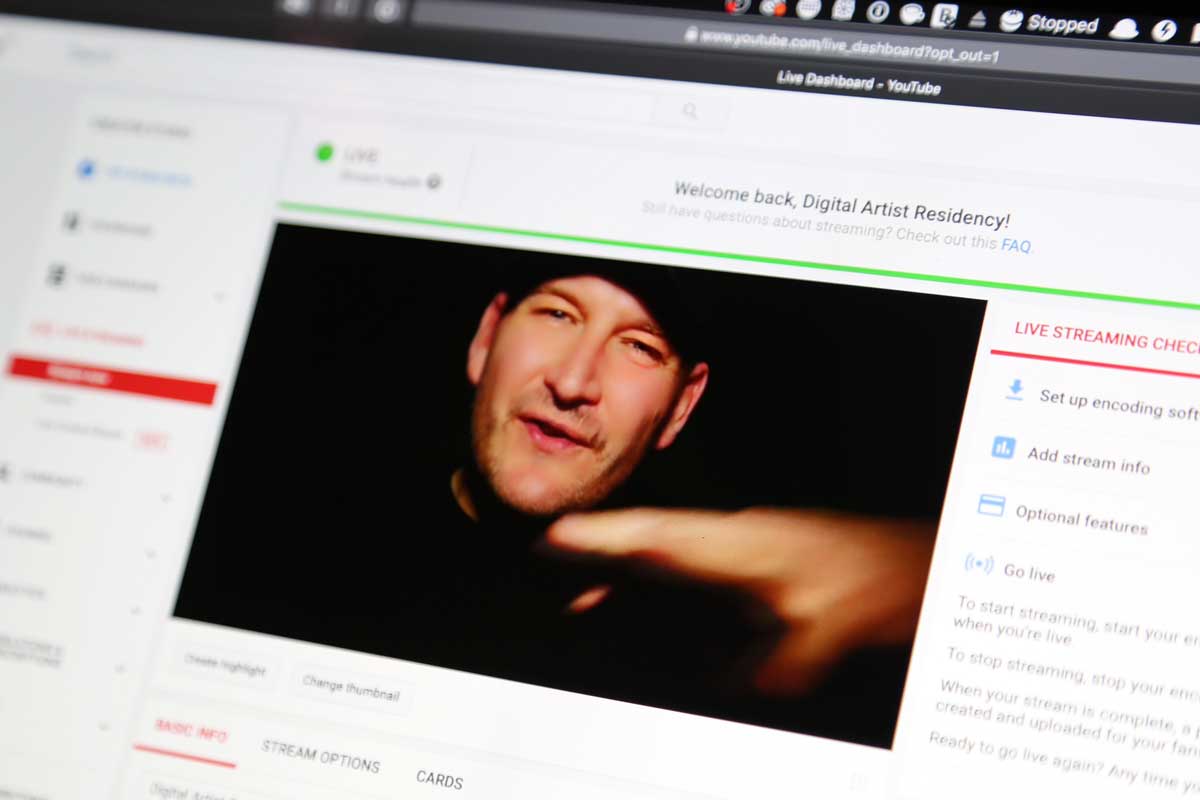
This Image is No Longer Available is a one-day event presenting a set of artist works, live-streamed performances, screenings and an open talks programme from researchers, artists, curators and visitors to discuss digital space and online presence. It is the culmination of our Activating our Archives project and is supported by the Digital Artist Residency.

Feat. Zarina Muhammad @zrnmhmmd and Akash Chohan, Mishka Henner @mishkahenner, Emile Zile @emilezile, Tom Milnes @tommilnes, Kathryn Eccles (Oxford Internet Institute) @oiioxford, Hermonie Spriggs (UCL Multimedia Anthropology Lab) @ucl_mal, Elliott Burns (Off Site Project) @offsiteproject1989, Digital Artist Residency (DAR), Sunil Shah @sunilphoto and Activating our Archives participants.

[…] 13.00 – 14.00 Live streamed performance from Australia by artist Emile Zile

Saturday, 27 April 2019 from 11:00-16:00

Performer / Audience / Lens (after Dan Graham)

On Saturday 11 August I’ll be performing a version of Dan Graham’s
1975 work; Performer / Audience / Mirror.

A performer faces a seated audience. Behind the performer, covering the back wall (parallel to the frontal view of the seated audience), is a mirror reflecting the audience.

Performer / Audience / Lens (after Dan Graham)
Emile Zile 2018

Export Happenings is a part of the MEL/NYC program, coinciding with the
2018 Melbourne Winter Masterpieces exhibition presented by the National
Gallery of Victoria in collaboration with The Museum of Modern Art in
New York.

http://nextwave.org.au/event/14471/

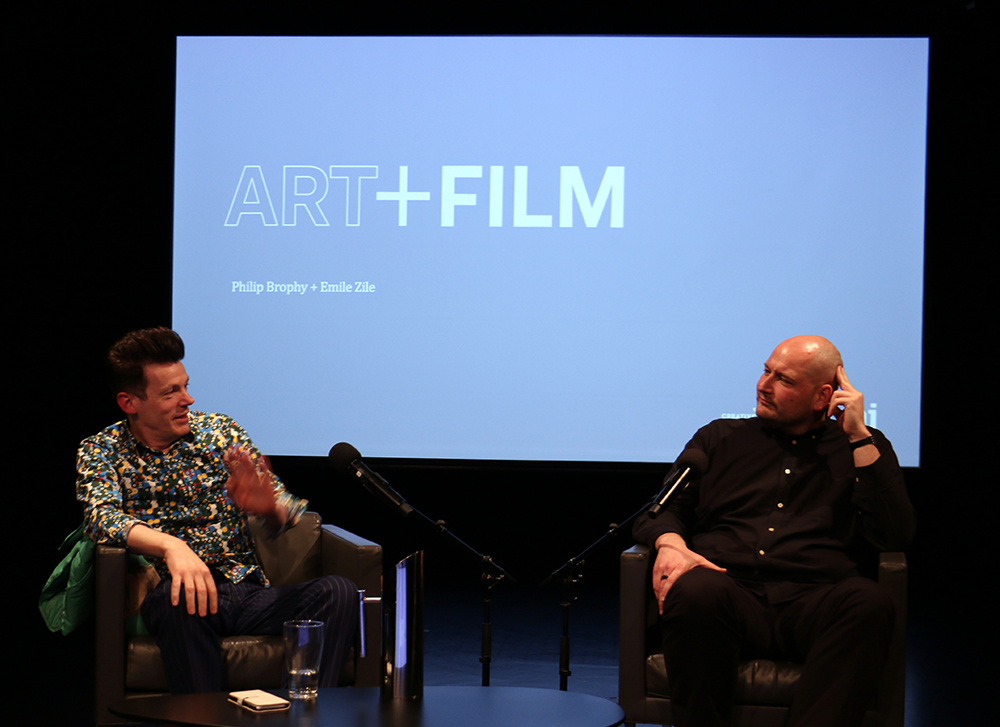
Emile Zile and Philip Brophy in conversation

Join Emile Zile and Philip Brophy for a conversational and unmoderated exchange as they select, screen and discuss each other’s video work. Both artists move horizontally between visual art, filmmaking and performance, working beyond the confines of strict categorisation. Their methods and tools are post-cinematic: scavenging and re-presenting the moving image material that surrounds them.

11 September 2017, 6.30pm
Free entry, bookings requested

Australian Centre for the Moving Image, Federation Square Melbourne

https://www.acmi.net.au/events/emile-zile-and-philip-brophy/